The Sensex Journey: A Story of Growth, Resilience, and Opportunity
Introduction: What is the Sensex?
The Sensex — short for the Stock Exchange Sensitive Index — is India’s benchmark stock market index, representing the performance of 30 financially sound and well-established companies listed on the Bombay Stock Exchange (BSE). Since its inception in 1986, the Sensex has not only tracked India’s economic progress but also mirrored the hopes, fears, and aspirations of millions of investors.
From its humble base value of 100 in 1978-79 to crossing the 70,000 mark in 2023, the Sensex’s journey is a testament to the resilience and potential of India’s economy. Let’s take a walk through its fascinating history, milestones, challenges, and lessons for investors.
🚀 The Inception and Early Days
The Sensex was first compiled and published in 1986, with the base year set to 1978-79 and an initial value of 100. This marked the beginning of a new era in Indian financial markets, providing investors with a reliable benchmark to gauge market performance.
By 1990, the Sensex crossed the 1,000 mark for the first time, signaling growing investor confidence in the Indian economy. This milestone came at a time when India was on the cusp of significant economic reforms, setting the stage for future growth.
📈 Major Milestones in the Sensex’s History
Over the decades, the Sensex has achieved several historic milestones, each reflecting broader economic trends and market sentiment:
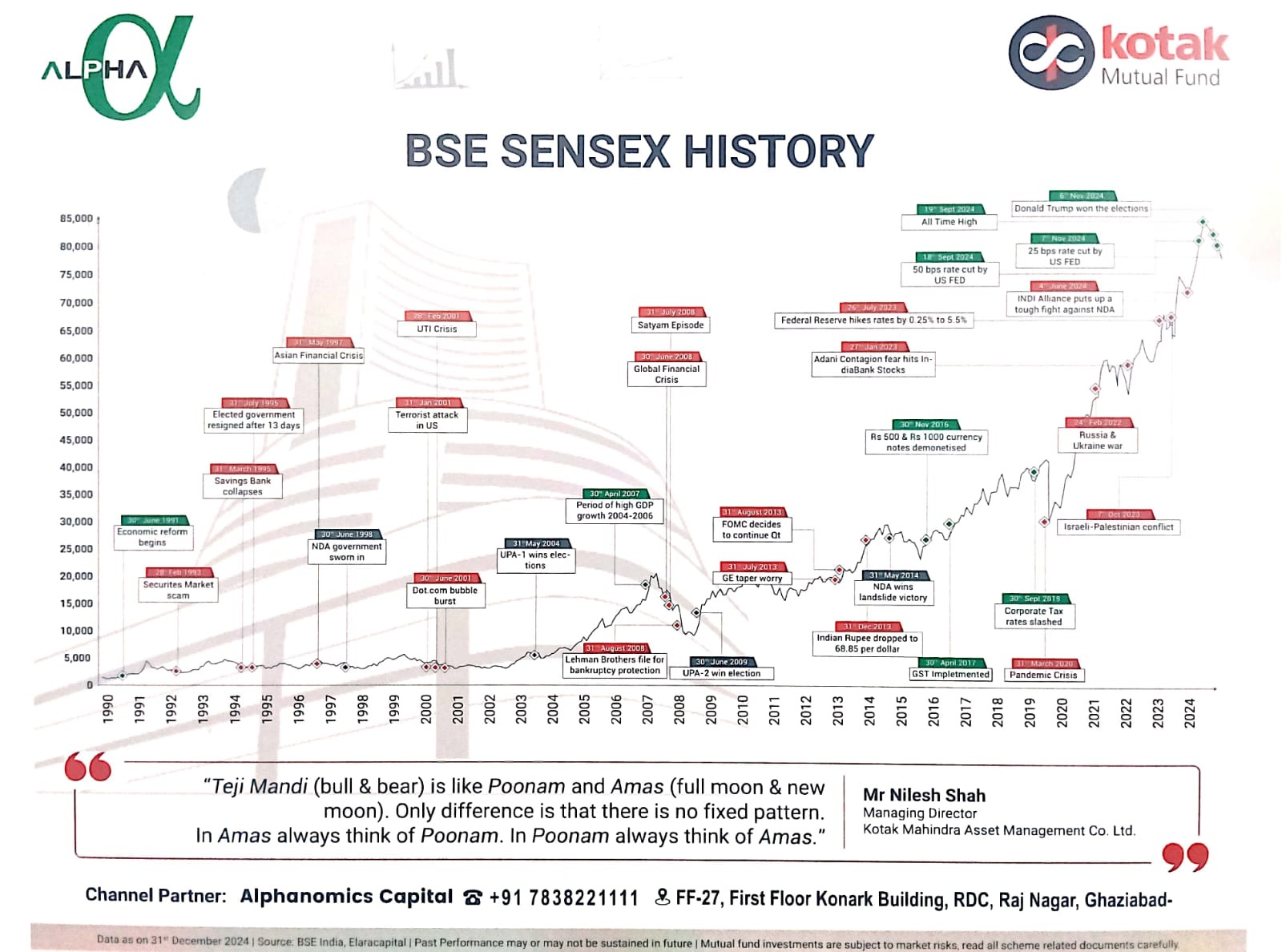
- 1992: The index surged past 4,000 during the infamous Harshad Mehta bull run. However, the scam that followed caused a sharp crash, highlighting the risks of unchecked speculation.
- 1999: It touched 5,000, riding the wave of the dot-com boom.
- 2006: The Sensex crossed 10,000 for the first time, fueled by India’s rapid economic growth and increasing foreign investments.
- 2007: In a year marked by unprecedented optimism, it soared past 20,000, cementing India’s position as an emerging global powerhouse.
📉 Navigating Crises: From Global Shocks to Recovery
No market journey is without its share of turbulence, and the Sensex is no exception. Here are some of the most challenging moments in its history:
- 2008: The global financial crisis hit hard, causing the Sensex to plunge from 20,000 to around 8,000. This period tested the nerves of even the most seasoned investors.
- 2009: The index rebounded strongly, regaining the 17,000 mark by year-end, thanks to government stimulus measures and renewed investor confidence.
These episodes underscore the inherent volatility of markets but also highlight their ability to recover and grow over time.
🌟 Recent Decade’s Growth: Scaling New Heights
The last decade has been particularly remarkable for the Sensex, as it scaled new peaks driven by strong corporate earnings, policy reforms, and robust GDP growth:
- 2014: It crossed 25,000, buoyed by hopes of economic reforms following the Lok Sabha elections.
- 2017: The Sensex touched 30,000 for the first time, reflecting sustained investor confidence.
- 2019: It surged past 40,000 after the NDA government’s re-election, signaling optimism about India’s future.
- 2020: The COVID-19 pandemic initially sent the Sensex crashing to around 26,000, but it made a remarkable recovery, crossing 50,000 in early 2021 — its fastest climb ever.
Fast forward to 2023, the Sensex crossed the 70,000 mark for the first time, driven by strong corporate earnings, resilient investor sentiment, and sustained FII inflows. As of 2024, it continues to trend upward, reflecting India’s growing stature on the global economic stage.
---
✨ Key Takeaways for Investors
The Sensex’s journey offers valuable lessons for investors:
1. Volatility is Inevitable: Markets are influenced by a wide range of factors, including global events, policy changes, and investor sentiment. Periodic booms and busts are part of the game.
2. Resilience Prevails: Despite crises like the Harshad Mehta scam, the global financial crisis, and the COVID-19 pandemic, the Sensex has consistently trended upwards over
the long term. This highlights the strength and potential of India’s economy.
3. Milestones Matter: From a base value of 100 in 1979 to over 70,000 in 2023, the Sensex has grown by more than 700 times in about 44 years. Patience and discipline are
key to benefiting from such long-term growth.
💡 Investment Wisdom: Lessons from Warren Buffett
As Warren Buffett famously said, “The stock market is a device for transferring money from the impatient to the patient.”
This timeless wisdom serves as a reminder: while the ride may be unpredictable, the rewards often favor those who embrace patience and discipline. Success in the stock market isn’t about timing the market; it’s about time in the market.
Stay focused on the bigger picture, avoid emotional reactions to short-term fluctuations, and remember — the Sensex’s journey is a testament to the power of long-term investing.
Looking Ahead: A Journey of Growth and Opportunity
The Sensex’s story is not just about numbers; it’s a reflection of India’s economic progress, resilience, and potential. Whether you’re a seasoned investor or a beginner, understanding the Sensex’s journey can provide valuable insights into navigating the world of investing.
As we look ahead, one thing is clear: while markets may remain volatile, opportunities abound for those who stay patient, disciplined, and focused on the long term.
Happy Investing!


.png)

.png)

.png)